
In metal forming operations, surface defects are often addressed through material substitution, tighter dimensional tolerances, or repeated mechanical adjustments. While these responses may offer short-term relief, they frequently fail to eliminate the problem at its source. In practice, many recurring defects originate not from the material itself, but from the tribological conditions governing tool–workpiece interaction.
Tribology—encompassing friction, wear, lubrication, surface topography, and contact pressure—controls how material flows, how heat is generated, and how surfaces degrade during forming. When these factors are poorly understood or inadequately controlled, defects become inevitable, regardless of material grade or machine capability.
Why Material-Centric Explanations Often Fall Short
When defects such as scoring, galling, pick-up, or surface tearing appear, material quality is usually the first suspect. Hardness, chemistry, or batch variability are scrutinised, and in some cases materials are replaced entirely. However, in many industrial investigations, the same defects persist even after multiple material changes.
This is because material behaviour in forming is inseparable from contact conditions. A perfectly compliant material can still fail if friction is excessive, lubrication collapses, or local contact pressures exceed the load-carrying capacity of the lubricant film. Without addressing these governing mechanisms, material changes merely mask the real issue.
The Role of Friction and Contact Pressure
Friction is not a constant input—it is an evolving response to pressure, sliding velocity, temperature, and surface condition. In metal forming, local contact pressures can reach levels that force lubrication into boundary or mixed regimes, where asperity contact dominates and adhesive wear becomes unavoidable.
As friction rises, so does frictional shear stress and heat generation. This creates a feedback loop: higher temperatures reduce lubricant viscosity, weaken additive performance, and further increase metal-to-metal contact. The result is unstable forming conditions that manifest as surface defects long before catastrophic failure occurs.
Lubrication Failure Is a Mechanical Problem, Not a Chemical One
Lubricant selection is often treated as a chemistry exercise—changing oil type, additive package, or supplier in response to wear. While chemistry matters, lubrication failure in forming processes is most often driven by mechanical overload rather than formulation alone.
If contact pressure exceeds the lubricant’s load-carrying capacity, no additive system can fully prevent film collapse. Effective lubrication therefore depends on matching lubricant performance to real operating pressures, surface roughness, and sliding conditions—not laboratory test data in isolation.
Why Trial-and-Error Adjustments Rarely Solve the Problem
Common responses to forming defects include adjusting roll gaps, increasing lubricant flow, reducing line speed, or polishing tooling surfaces. While these measures may reduce defect severity temporarily, they rarely provide a stable long-term solution.
Without quantifying contact pressure, frictional stress, and thermal input, adjustments are made blindly. In many cases, improvements in one area simply shift the problem elsewhere in the process. A tribology-led analysis replaces guesswork with measurable, predictive insight.
A Root-Cause Approach to Metal Forming Defects
Effective defect elimination requires treating tribology as a governing design parameter. This involves understanding where sliding occurs, how pressure is distributed, when lubrication transitions between regimes, and how heat accumulates throughout the forming process.
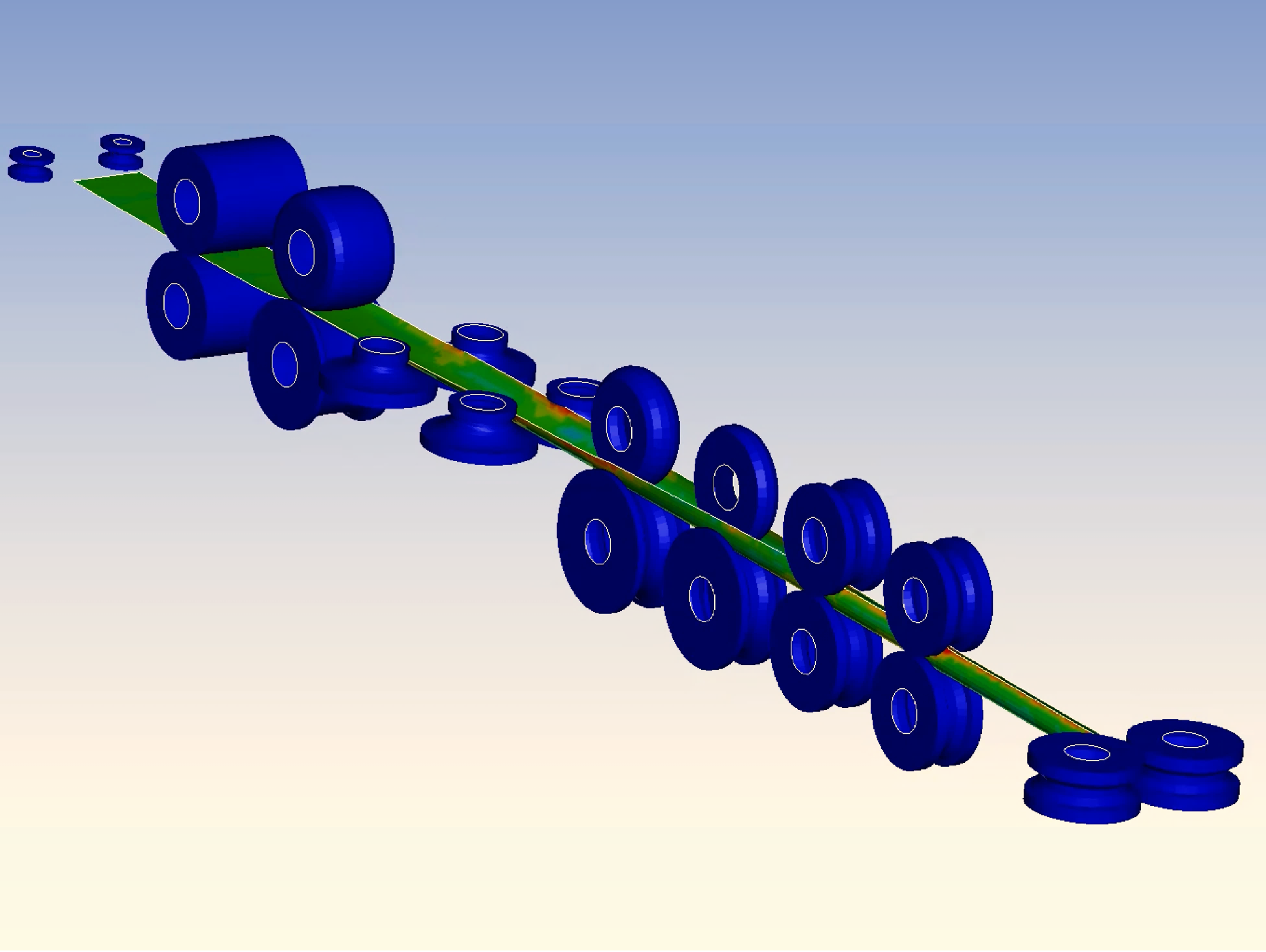
By combining contact mechanics, material behaviour, and realistic friction modelling—often supported by advanced mechanical simulation—defects can be predicted, not just observed. This allows corrective action to be taken at the design and setup stage, rather than after production losses occur.
Metal forming defects are rarely random and seldom purely material-driven. In most cases, they are the visible outcome of underlying tribological imbalance. Treating tribology as an integral part of process design—rather than a secondary consideration—transforms defect resolution from reactive firefighting into controlled engineering.
At Murray Hill Engineering, we specialise in identifying and resolving these root causes by linking real operating conditions to friction, wear, and lubrication behaviour. The result is not only defect reduction, but more stable processes, longer tool life, and predictable production performance.