
Most manufacturing failures are not caused by a single dramatic mistake. They develop quietly. A little extra sliding where rolling was assumed. Local contact pressures that are higher than expected. Heat that accumulates over several stations instead of dissipating. By the time defects become visible on the shop floor, the underlying mechanisms have often been active for weeks—or even months.
Mechanical and tribological simulation is valuable not because it replaces physical trials, but because it exposes these mechanisms early, when they are still cheap to fix. When used properly, simulation shifts engineering effort upstream—from firefighting during production to informed decision-making during process design.
Where Traditional Process Validation Breaks Down
In many forming operations, validation still means “try it and see.” Tooling is commissioned, parameters are adjusted incrementally, and problems are diagnosed from the finished product. This approach can confirm whether a process is acceptable, but it offers very limited insight into why certain limits exist.
More importantly, trial-based validation tends to hide coupled effects. A change that improves surface finish may increase contact pressure elsewhere. A speed reduction that stabilises forming may push lubrication into a different regime. Without visibility of these interactions, engineers are often tuning symptoms rather than addressing causes.
What Mechanical Simulation Is Actually Useful For
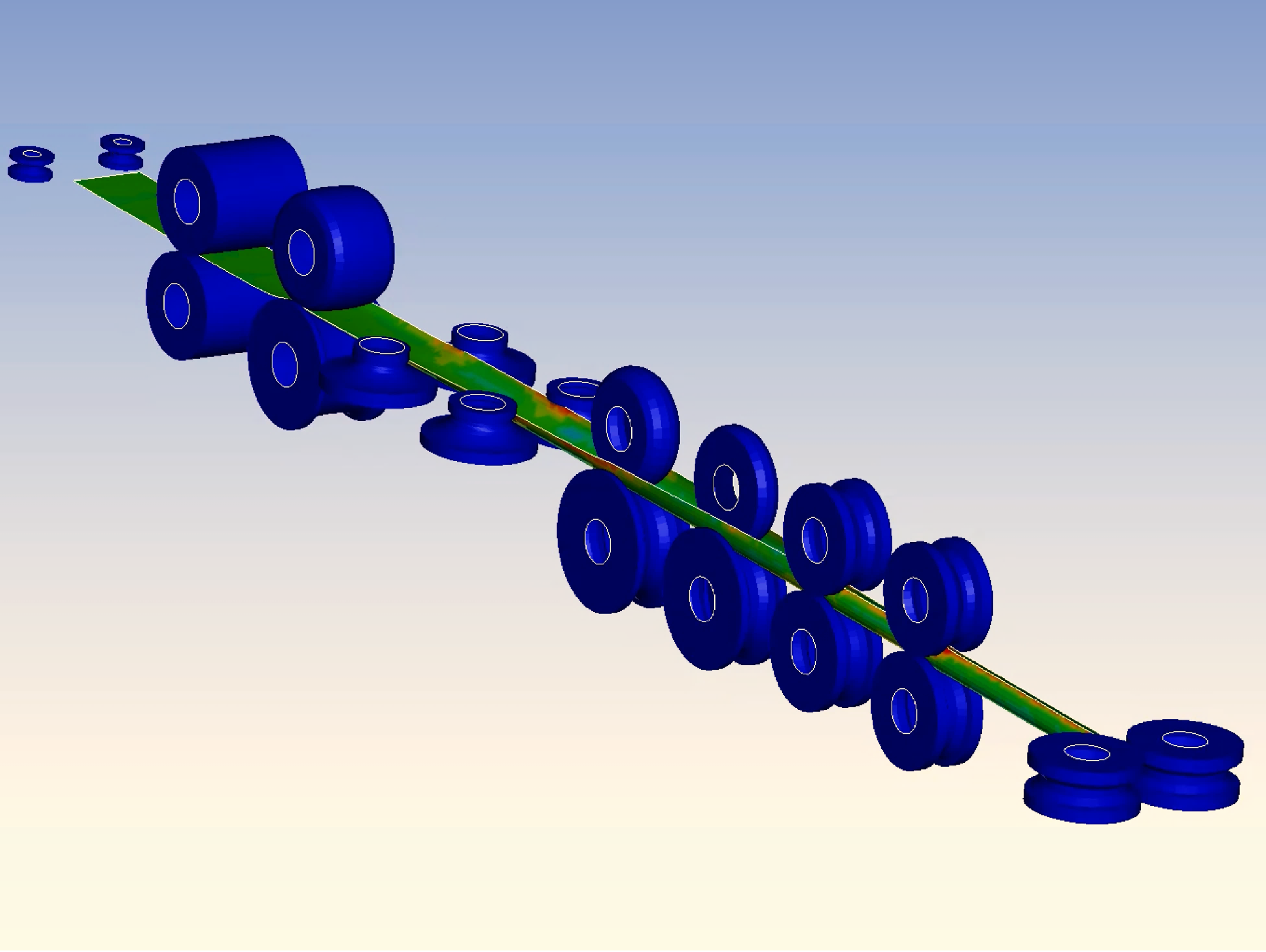
Mechanical simulation earns its value when it is used to answer specific questions, not to generate attractive contour plots. In forming processes, those questions usually relate to load paths, constraint, and material flow: where forces concentrate, how deformation evolves from one stage to the next, and which regions of the workpiece are being over-driven.
For rolling, drawing, and tube mill forming in particular, simulation can reveal whether a process is genuinely dominated by rolling contact or whether sliding is doing more work than intended. That distinction matters, because sliding—not deformation itself—is often what drives heat, wear, and surface damage.
Why Tribology Is Usually the Missing Piece
One of the most common weaknesses in forming simulations is how tribology is treated. Friction is frequently assigned a single constant value, chosen to help the model converge rather than to reflect reality. Lubrication is assumed to “work” until it visibly does not.
In reality, friction evolves continuously with pressure, sliding speed, surface condition, and temperature. When contact pressure increases beyond the load-carrying capacity of the lubricant film, no amount of chemical optimisation will prevent metal-to-metal interaction. Tribological simulation brings this behaviour into focus, allowing engineers to see where lubrication regimes change and where wear mechanisms are likely to initiate.
Identifying Failure Mechanisms, Not Just Defects
When mechanical and tribological models are combined, the discussion moves away from visible defects and toward failure mechanisms. Excessive frictional shear stress, localised thermal build-up, unstable transitions between rolling and sliding, or repeated boundary lubrication conditions can all be identified long before they leave marks on a component.
This is where simulation becomes genuinely preventive. Instead of reacting to scrap or tool damage, engineers can modify tooling geometry, surface finish, lubrication strategy, or process sequencing with a clear understanding of why those changes are effective.
Reducing Reliance on Costly Physical Trials
Physical trials will always have a place in manufacturing, but their role should be confirmation rather than discovery. Simulation reduces the number of trials needed by narrowing the solution space. Poor design choices are eliminated virtually, before material, time, and production capacity are consumed.
For processes involving high-value materials or complex tooling, this reduction in trial-and-error can represent a substantial cost saving. More importantly, it reduces the risk of committing to process limits that only become apparent after full-scale production begins.
Turning Simulation into a Practical Engineering Tool
Simulation does not automatically deliver insight. Its usefulness depends entirely on how well its assumptions reflect real operating conditions. Material models, contact definitions, friction behaviour, and boundary conditions must all be chosen with the process—not numerical convenience—in mind.
At Murray Hill Engineering, simulation is used as an investigative tool rather than a sales artefact. The objective is always the same: to understand what will limit the process, where instability will originate, and how those limits can be moved safely before production starts.
Mechanical and tribological simulation does not eliminate the need for experience—it amplifies it. When combined with an understanding of real forming behaviour, it allows engineers to see problems developing long before they become expensive. Used this way, simulation is not about prediction for its own sake, but about making manufacturing more controlled, repeatable, and resilient.