
Magnetic levitation systems promise something extremely attractive to industry: zero mechanical contact, no lubrication, minimal wear, and high efficiency. In clean environments, these advantages are relatively easy to realise. In hazardous or explosive atmospheres, however, the engineering challenge changes completely.
Designing a maglev blower or motor that is genuinely safe in ATEX or IECEx zones is not a matter of adding protection layers at the end of the design. It requires a fundamental understanding of how instability develops, how failure modes cascade, and where certification bodies will focus their scrutiny. This is where many otherwise impressive maglev projects struggle.
The Real Risk Is Not Sparking — It Is Loss of Stability
Sparking is often cited as the primary safety concern in maglev systems operating in hazardous zones. In practice, sparking is a consequence, not a cause. The underlying problem is almost always rotor instability.
When a levitated rotor becomes unstable—due to external vibration, asymmetric magnetic forces, airflow-induced disturbances, or control lag—it can approach or contact surrounding components. In a conventional machine this may result in wear. In a hazardous environment, it becomes a certification-blocking event.
The correct engineering response is not to focus narrowly on spark suppression, but to eliminate the conditions that allow instability to develop in the first place.
Why “Backup Bearings” Are Often the Weakest Link
Auxiliary or backup bearings are frequently presented as a safety feature in maglev systems. In hazardous environments, they are more often the opposite. When levitation is lost, the rotor does not gently settle. It transitions instantaneously from zero speed relative motion to high-speed contact.
This impact generates heat, friction, and sparks—exactly the phenomena explosion-proof standards are designed to prevent. Attempting to “manage” this event with materials or coatings is rarely acceptable to certification bodies.
A more robust strategy is to avoid mechanical contact altogether. Passive magnetic bearings, combined with short-duration power backup for active bearings, fundamentally change the failure scenario. Instead of impact, the system transitions into a controlled, contactless state.
Cooling Systems Are a Hidden Certification Trap
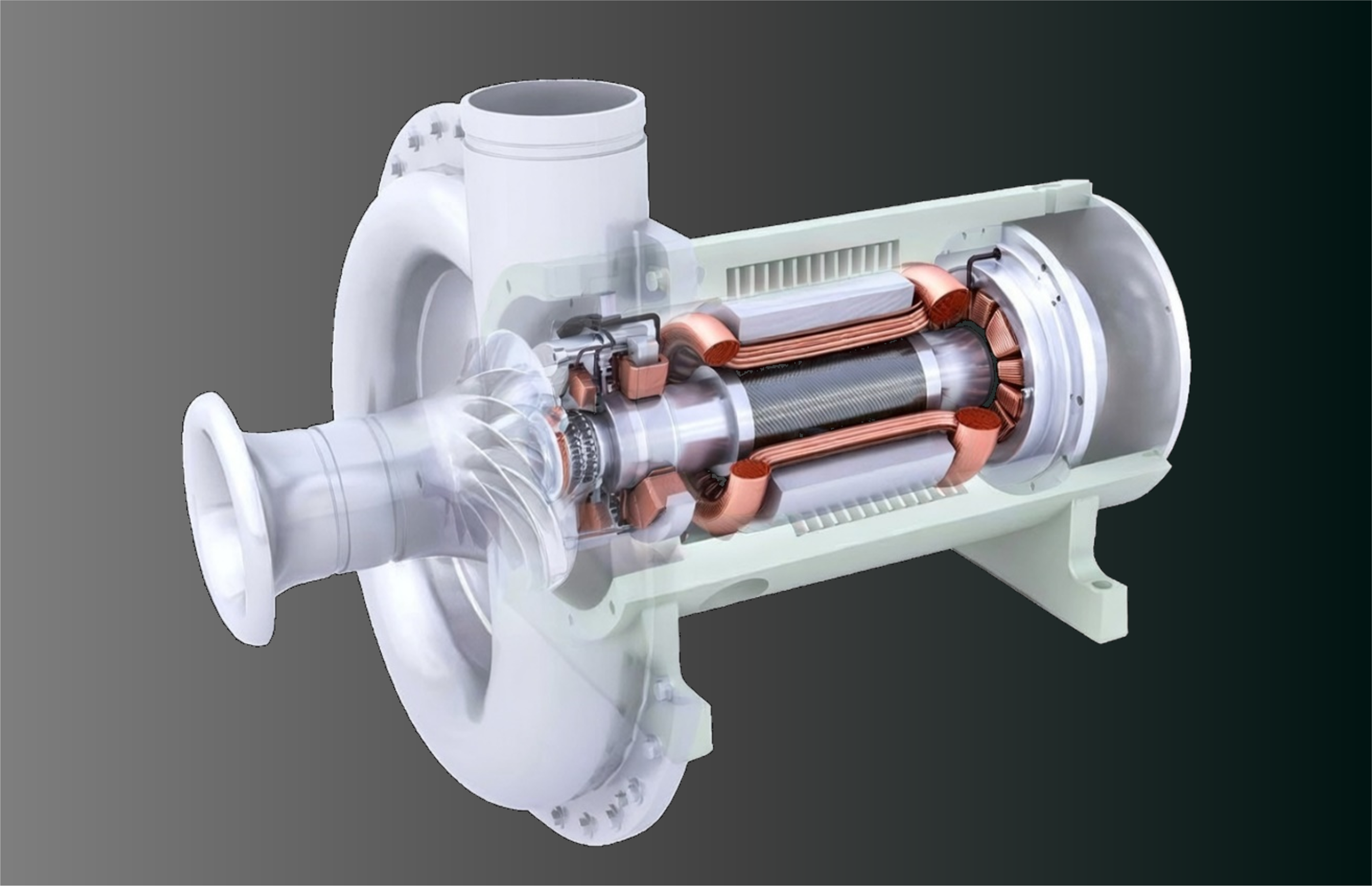
Cooling is one of the most underestimated challenges in explosion-proof maglev design. Open airflow paths that pass through the motor interior may appear efficient, but they directly compromise enclosure integrity. They also introduce dust, moisture, and flow-induced forces that destabilise the rotor.
From a safety perspective, fully enclosed architectures with external cooling or liquid jackets are vastly more defensible. From a dynamic perspective, they also improve stability by removing unpredictable aerodynamic excitation from the levitation gap.
Purged systems can be made compliant, but they introduce their own complexity and control dependencies. In many cases, they solve one problem while creating two others.
Control Strategy Matters More Than Many Teams Realise
Maglev systems are inherently non-linear. Yet many designs still rely on control strategies that were never intended to manage strong coupling between magnetic fields, thermal drift, airflow disturbances, and structural vibration.
Simple PID control can function under ideal conditions, but it struggles when delays, non-linear stiffness, or asymmetric loading appear. In hazardous applications, these edge cases are precisely what matter most.
More advanced approaches—such as model-based or predictive control—allow instability to be addressed before it manifests physically. From a certification standpoint, this also provides a clearer, more defensible explanation of how safety is actively maintained.
Explosion-Proof Design Is a System Problem, Not a Component Problem
One of the most common reasons maglev projects stall during certification is a fragmented design approach. Bearings are designed in isolation. Cooling is treated separately. Control electronics are added late. The result is a system that functions, but cannot be convincingly proven safe.
Certification bodies assess behaviour under fault conditions, not nominal operation. They want to understand what happens when power is lost, when sensors drift, when airflow changes, and when tolerances stack unfavourably. Only a holistic design can answer those questions convincingly.
Our Perspective at Murray Hill Engineering
Our work with magnetic levitation systems focuses on identifying where instability originates and how it propagates through the system. We do not start with certification checklists. We start with physics, dynamics, and failure behaviour.
By addressing rotor dynamics, magnetic field symmetry, damping, control latency, and enclosure design together, we help clients move from “technically impressive” concepts to systems that are robust, defensible, and certifiable in real industrial environments.
Magnetic levitation is not inherently unsafe in hazardous environments—but it is unforgiving of shortcuts. Stability must be designed, not assumed. Failure modes must be eliminated, not mitigated after the fact. When these principles are applied consistently, maglev systems can achieve both exceptional performance and the highest levels of safety.